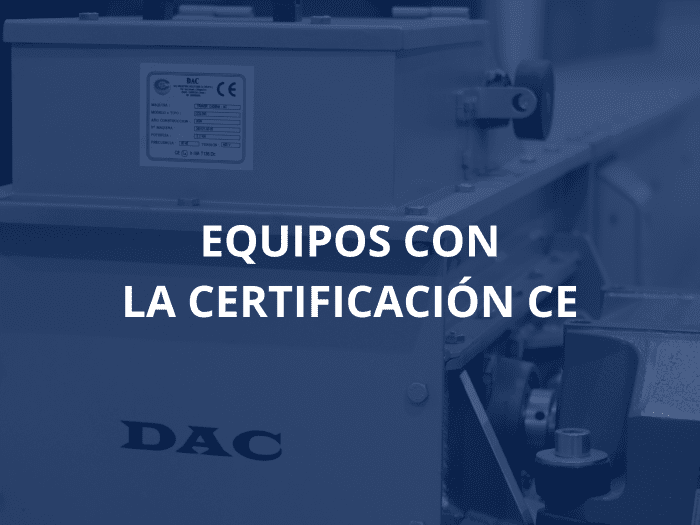
On January 20, 2027, Regulation (EU) 2023/1230 becomes mandatory and replaces Directive 2006/42/EC, the standard under which much of the machinery currently in use at any facility in our country has been certified.
If, for example, you run an animal feed factory, an agri-food plant, or a biomass facility, the question isn’t whether this affects you (it does), but rather which part of your machinery fleet you need to review and when you should start.
If, on the other hand, you’re thinking about purchasing new equipment, we recommend reading this article to learn what you need to consider. If you’re still unsure whether you should replace your machinery, you can review this guide to help you decide.
What Is Regulation (EU) 2023/1230?
It is the new European machinery safety regulation. It was published on June 29, 2023, entered into force on July 19 of that year, and will become generally mandatory on January 20, 2027. As of that date, it repeals Directive 2006/42/EC.
At DAC Industrial, we continually adapt to legal requirements to ensure the safety of our products, which are manufactured in accordance with the Machinery Directive and harmonized standards of the European Union.
The change in legal status is no minor detail: a directive is transposed into each country’s national legislation, whereas a regulation is applied directly and uniformly across all member states, leaving less room for national interpretation.
What Has Changed Compared to Directive 2006/42/EC
- Software and cybersecurity: control systems and software with safety functions now fall squarely within the scope of the regulation.
- Artificial intelligence: Safety functions with adaptive behavior are expressly covered.
- Digital documentation: Instructions may be provided in digital format, subject to certain conditions.
- High-risk machinery: The list and the conformity assessment procedure for certain categories have been revised.
For a bulk solids processing plant, the two points that most commonly affect compliance are the treatment of control software and the documentation associated with substantial modifications.
What about machinery you already have installed?
The general rule is that the standard applies to machinery placed on the market on or after the date of application. Machinery that was legally placed on the market prior to that date does not need to be recertified simply because the standard has changed.
An important distinction arises when that machine is modified. If the modification is substantial (a change to the machine that the manufacturer did not anticipate and that affects its safety), it may be considered a new machine, and in that case, the standard in effect at that time does apply. Replacing a broken motor is not the same as reconfiguring an entire production line.
It’s a distinction that should be clear before undertaking an expansion, not after.
How to Know If Your Plant Is Ready
- Do you have the EC Declaration of Conformity and the manual for each piece of equipment on hand?
- Do you have written documentation of every change made to a machine since its installation?
- Do you know who is listed as the manufacturer for lines assembled with equipment from multiple suppliers?
- Do your conveying and dosing systems have legible identification plates and associated documentation?
- Have you reviewed how the regulatory change will affect you if you purchase or expand your machinery in 2026 or 2027?
If you answered “no” to two or more of these questions, it’s worth conducting a document review before the deadline arrives.
What We Do at DAC
We manufacture conveying, grinding, mixing, dosing, and dust collection equipment, complete with documentation and identification plates, and assist with integration into existing production lines. When an expansion may be considered a substantial modification, we’ll let you know before we begin.
In addition, we take care of your equipment by offering a maintenance service tailored to your plant’s needs.
Our Products
Frequently Asked Questions
When does Regulation (EU) 2023/1230 take effect?
January 20, 2027. Until that date, Directive 2006/42/EC remains the applicable standard for machinery placed on the market prior to that date.
Do I have to recertify the machinery I already own?
Generally speaking, no, provided it was lawfully placed on the market before the date of application and is not subject to a substantial modification.
What is considered a substantial modification?
A substantial modification is a change to the machine that the manufacturer did not anticipate and that affects its safety—for example, because it requires the addition of guards that alter the control system, or new measures for stability or mechanical strength.
Who is the manufacturer of a production line assembled with equipment from different suppliers?
Whoever integrates the assembly and puts it into service as a functional unit assumes the obligations of the manufacturer of the assembly.
Do you have questions about your production equipment?
We’ll review the documentation and technical condition of your equipment with you and let you know what needs to be updated and what doesn’t.
Request your no-obligation technical assessment
Text drafted with the help of AI tools.